Rolling Down the Yield Curve
November X, 2026

Why the passage of time can create a return opportunity in bond portfolios and why the shape of the curve matters.
For institutional investors, selecting a maturity is not simply a choice among available yields. It is a total-return decision shaped by the portfolio’s investment horizon, liquidity needs, benchmark considerations, objectives, and tolerance for interest-rate risk.
A bond investor’s return is not determined by yield alone. In addition to income, bond total returns also reflect price changes, which include changes in market interest rates and credit spreads, and the way a bond’s valuation changes as it moves closer to maturity. That last component is often called “roll-down.” When the yield curve has a favorable, upward sloping shape, roll-down can provide an additional source of potential return without requiring a broad directional move in interest rates.
When rates rise across the yield curve, the “roll-down” concept deserves renewed attention. The enduring lesson, however, is not that investors should always extend maturities, but that the yield curve’s shape can affect the return and risk of every maturity decision. Investors who evaluate bonds only by their starting yield may overlook an important part of the total return opportunity set.
What does it mean to roll down the yield curve?
A yield curve compares the yields of bonds with similar credit quality across different maturities. In a positively sloped curve, longer-maturity bonds generally yield more than shorter-maturity bonds. If the yield curve remains unchanged, a bond purchased at a longer maturity may be valued at a lower yield simply due to the passage of time as the bond becomes a shorter-maturity security.
Because bond prices generally rise when yields fall, that natural movement “down the yield curve” can create price appreciation in addition to the income earned from the bond. The investor does not need market yields to move lower. The potential benefit comes from the bond “rolling” to a lower-yielding point on an otherwise unchanged curve.
Consider a simplified example. An investor buys a high-quality bond with several years remaining to maturity. One year later, the bond has one less year to maturity. If bonds at that shorter maturity trade at lower yields and the relevant curve has not otherwise changed, the bond’s price may be higher. The investor’s return would then reflect both the income received and the change in price associated with simply moving along the curve.
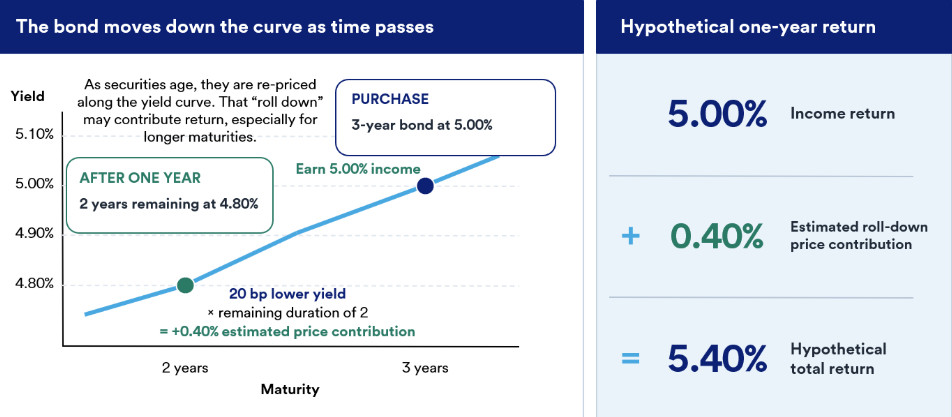
How roll-down may contribute to a bond’s one-year return
Hypothetical example for illustrative purposes only. Assumes an unchanged yield curve and stable credit and liquidity conditions. Actual results will differ.
Curve shape determines whether roll-down helps
Roll-down is most intuitive when the curve slopes upward, but the size of the opportunity depends on where the curve is steepest. A decision to invest in a specific segment along the yield curve may offer more potential roll-down than a decision to invest in a longer-dated part of the curve with a relatively flatter segment. This makes curve positioning a relative-value decision rather than a simple choice between “short” and “long” bonds.
Consider a simplified example. A boulder will roll down a steeper hill faster than on a hill with a flatter slope. The faster a boulder may roll down the hill is analogous to the opportunity a bond investor may reap from “roll-down” components of total return.
An inverted curve, however, changes the calculation. When shorter maturities yield more than longer maturities, the passage of time may move a bond toward a higher-yielding point on the curve or “rolling up the curve.” All else equal, that can create a price headwind rather than a benefit. In that environment, high front-end yields may still be attractive, but the source of return is different. Income, reinvestment assumptions, and the expected path of policy rates may matter more than positive roll-down.
A flat curve can also limit the potential benefit. If yields are similar across the yield curve, extending maturities may add duration risk without offering meaningful additional income or roll-down potential. The key question in this case is not whether roll-down “works,” but whether the expected compensation at a particular point on the curve is attractive relative to the added risks.
Roll-down is not a free return
The standard illustration assumes an unchanged yield curve, stable credit environment, and sufficient market liquidity. Actual markets rarely hold all three concepts constant. A rise in yields can offset income and expected roll-down. A curve can steepen, flatten, or invert. Credit spreads can widen. A bond can become less liquid or experience a deterioration in fundamentals. Transaction costs can also reduce the value captured by repositioning the portfolio.
Duration remains especially important. Extending maturity to pursue roll-down generally increases sensitivity to changes in interest rates given the increased portfolio duration. The potential return should be evaluated against the loss that could occur if yields rise more than expected, which can be achieved by running scenario analyses and shocking the current yield curve using various assumptions (e.g., yields rising and the curve steepening, spreads widen sharply, a dramatic fall in yields across the curve, etc.). Comparing the results will help an investor weigh the opportunity costs of an investment decision.
Security selection also matters. Two bonds with similar maturities and yields may have different call features, liquidity profiles, credit risks, and/or cash-flow structures. A bond with an attractive position on the curve may still be unattractive relative to a similar security if you are not being adequately compensated for the risk associated with the underlying structure and issuer.
A practical framework for investors
Rather than treating roll-down as a stand-alone trade, institutional investors can incorporate it into a broader portfolio construction process:
Start with the portfolio objective. Liquidity needs, liability timing, risk tolerance, benchmark or other portfolio constraints, and the investment horizon should govern how much maturity and duration risk the portfolio can accept.
Evaluate total return, not yield in isolation. Compare expected income, potential roll-down, reinvestment assumptions, and plausible price changes across maturities.
Focus on curve segments. The slope between two specific maturity points may be more decision-useful than a general statement that the curve is steep, flat, or inverted.
Test the breakeven. Estimate how far yields could rise before income and potential roll-down are offset by price depreciation. Consider parallel and nonparallel curve shifts.
Assess security-specific risk. Credit, liquidity, optionality, and structure can overwhelm an otherwise attractive curve position.
Revisit the analysis. The opportunity changes as yields, curve shape, valuations, and the remaining investment horizon change.
The enduring implication
Roll-down illustrates a broader principle of active fixed income management: time changes a bond even when the market narrative does not. A security’s maturity shortens, its sensitivity to rates evolves, and its position on the yield curve changes. Those mechanics can create opportunities, but only when considered alongside the portfolio’s objectives and the risks required to pursue them.
For institutional investors, the practical takeaway is to look beyond the highest available yield. The more useful question is how a bond is expected to behave over the intended holding period. Assessing income, roll-down, curve scenarios, and downside risk together can lead to more deliberate investment decisions across market environments.
If you have any questions or would like more information, please reach out to your relationship manager.