From Manager Selection to Portfolio Construction: How Manager Research Supports OCIO Portfolio Outcomes
September X, 2026

In an outsourced chief investment officer (OCIO) mandate, manager selection is not simply a search for strong standalone investment managers. It is a portfolio construction discipline that helps determine where active management may be most effective, how complementary managers can be combined, and how ongoing oversight can support client objectives through changing market conditions.
Strategic asset allocation establishes a portfolio's long-term objectives, but implementation decisions ultimately determine how those objectives are expressed within the portfolio. Manager research helps bridge the gap between investment strategy and portfolio construction by identifying managers whose characteristics align with the role each allocation is intended to serve.
Active vs. Passive Decisioning Across Asset Classes
Manager research helps inform not only which managers are selected, but whether active management is appropriate in the first place. Market efficiency varies across asset classes and investment styles. In some areas, skilled managers may be better positioned to exploit inefficiencies or security-level opportunities. In others, passive exposure may provide a more efficient means of seeking market returns.
Evaluating where active management can add value is an important component of portfolio construction and implementation. Portfolio alpha can be derived from both tactical allocation and manager selection with the intention of helping clients meet long term goals. The goal of manager selection within the portfolio construction process is to create an appropriate lineup for a portfolio with every manager playing a role while counterbalancing for another manager or managers, depending on the sub-asset level.
The approach is like creating a traditional baseball lineup. Different managers have different roles like how batters have different duties depending on their spot in the lineup. The leadoff hitters are tasked with getting on base, so they are more focused on hitting singles. Subsequent batters look to advance runners along the bases by either hitting for a single or more power. In manager selection, portfolio needs and market characteristics help determine the appropriate balance between managers that have consistently generated excess returns with controlled tracking error and managers that may offer greater upside potential in exchange for additional risk. The aim is to select different managers that collectively work toward a portfolio’s objectives.
Combining Complementary Managers
A portfolio’s success depends not only on the quality of its individual managers, but on how those managers work together. Evaluating managers within the context of the broader portfolio can help reduce unintended concentrations, improve diversification, and ensure that each allocation contributes to the portfolio’s overall objectives.
Complementary managers may differ in investment style, factor exposures, portfolio construction approaches, or sources of return. Managers may have different exposures to factors such as quality or size for equities, or duration and credit risk for fixed income. Portfolio construction methodologies can also vary significantly. For example, a manager employing an equally-weighted portfolio with periodic rebalancing may benefit from systematically trimming appreciated positions and reallocating to lagging holdings. In contrast, a manager using a more buy-and-hold approach may allow successful investments to become larger portfolio positions over time. These approaches may perform differently across market environments, and understanding those differences can help create a more balanced portfolio than any single manager could provide on its own.
Additionally, evaluating managers in isolation can overlook how investment strategies interact once combined within a portfolio, potentially leading to unintended consequences or correlations. For example, doing a search a year ago for an emerging markets manager and now doing another search to add another emerging markets manager could result in overlap in manager characteristics if done in isolation based on similar quantitative criteria being utilized within the screening process. The unintended effect is the increased probability that the second manager has higher correlations to the manager that was chosen in the prior year, hence undermining diversification[. Factor-based analysis can help identify the underlying sources of return within each strategy, reducing the likelihood of selecting managers with overlapping exposures and increasing the potential for meaningful diversification, if the appropriate tools are available.
Quantitative and qualitative assessments of managers within the broader portfolio context help ensure that each allocation contributes to the portfolio’s objectives while avoiding unnecessary overlap. Two portfolios with identical strategic asset allocations can experience different results depending on how underlying managers are selected and combined. Manager research helps inform these implementation decisions by evaluating not only individual manager characteristics, but also how managers fit together within the broader portfolio structure.
Manager research is not only about selecting managers. It is about understanding how managers interact. Returning to the baseball analogy, each manager serves a distinct role within the portfolio just like baseball players throughout a lineup each have their designated position. Some managers may be expected to generate excess returns through security selection, while others may provide diversification or risk management benefits. The objective is not to assemble a collection of strong managers, but to build a complementary manager structure designed to improve portfolio outcomes.
Analyzing factor exposures can help identify whether managers are likely to behave differently during changing market environments, improving diversification and reducing reliance on a single investment approach. Broadly, better understanding how returns are earned — whether from investment skill, portfolio construction decisions, or market conditions — helps evaluate if portfolio performance is likely to be repeatable in the future.
Foundations of Manager Research and Ongoing Monitoring
Successful manager selection requires looking beyond historical returns. Understanding the organization, investment team, decision-making process, and long-term results can help determine whether a manager’s strengths are repeatable and aligned with a portfolio’s objectives.
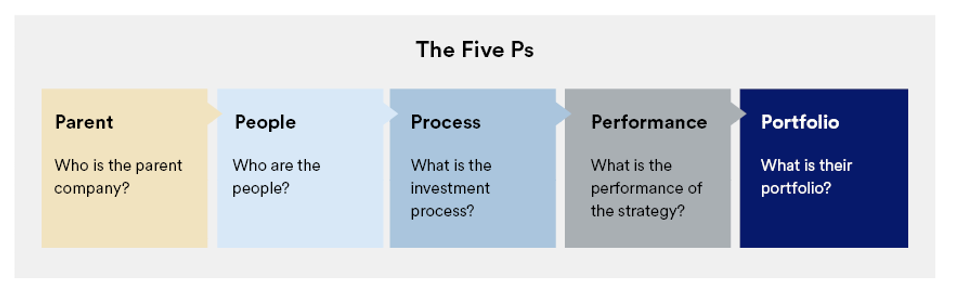
This assessment, called the “Five Ps,” considers a manager’s parent company, the people overseeing strategy and decisions, the investment processes, and how strategies perform.
- Who is the parent company? What is the firm’s history, ownership structure, and organizational stability?
- Who are the people? Who are the people who oversee the strategy, how is the team structured, and what is the decision-making process? Is there key man risk?
- What is the investment process? How do they define their initial universe? Are they filtering, sifting, or employing a quantitative methodology? If using a quantitative methodology, what is the source of the data and how are they ensuring the inputs for the model are accurate? Have they incorporated artificial intelligence? How does their process result in the factor exposures within their portfolio?
- What is the performance of the strategy? How have they performed over calendar years and various rolling periods from an absolute and relative basis? How does their excess return stream correlate to other managers in the portfolio? What are their risk metrics and do they coincide with the exposures we desire or the intended outcomes of their investment process and portfolio construction methodology?
- What is their portfolio? Is their style consistently mapping to expectations or is it drifting? What is the primary alpha source? Are they dependent on one sector or region or multiple? Is there a significant number of outliers within their portfolio or is clustering evident?
Finally, once a manager is onboarded, ongoing monitoring helps determine whether managers continue to fulfill their intended roles within the portfolio and whether changes in personnel, process, or risk profile warrant additional scrutiny. Performance is evaluated within the context of a manager's stated philosophy, portfolio characteristics, and intended role rather than in isolation.
Conclusion
Manager research is not simply about identifying skilled investment managers. Within an OCIO framework, it is an essential portfolio construction discipline that helps determine where active management may add value, how managers can work together to support portfolio objectives, and whether investment strategies continue to fulfill their intended roles over time.
The long-term success of a portfolio depends not only on asset allocation decisions, but also on how those decisions are implemented. By informing active-versus-passive decisions, evaluating complementary manager structures, and providing ongoing oversight, manager research helps create a clearer connection between portfolio design and client objectives.
For OCIO clients, disciplined manager research and selection can help support:
- More intentional portfolio construction, with managers selected based on both their distinct role within the portfolio and how they complement other managers
- Identify unintended portfolio risks and concentrations
- Stronger oversight and accountability through ongoing monitoring
- Greater alignment between a portfolio's design and its long-term investment objectives
If you have any questions or would like more information, please reach out to your relationship manager.