Introduction to Our OCIO Investment Process: Strategic Asset Allocation Framework
April X, 2026

Our outsourced chief investment officer (OCIO) investment team is committed to delivering multi-asset-class solutions that seek to add value for clients through asset allocation and manager selection, disciplined portfolio construction, and robust governance. As part of our three-part series on the OCIO investment process, the first paper introduced the four pillars of our approach: governance; strategic and tactical asset allocation; vehicle selection; and portfolio implementation. In this second paper, we discuss the foundational building blocks of our strategic asset allocation framework — the central pillar of the investment process.
For each client seeking to generate long-term returns, we develop a strategic asset allocation framework that outlines expected return and risk characteristics across intermediate- and long-term horizons. To build well-diversified portfolios, the framework incorporates equities, fixed income, listed real assets, and alternatives (including private capital strategies). Return and risk expectations derived from our Capital Market Assumptions are used to align portfolios with client return requirements and risk tolerance levels.
When establishing strategic asset allocation targets with clients, we incorporate long-term return expectations, volatility, and correlations as core inputs to portfolio construction. In our view, the decision to include an asset class in a multi-asset-class portfolio should not be based solely on absolute return expectations; it should also reflect the underlying drivers of return and risk, as well as how the asset class fits within the broader portfolio. Focusing only on short- to intermediate-term differences in absolute returns can lead to concentrated portfolios and reduce portfolio resilience over time.
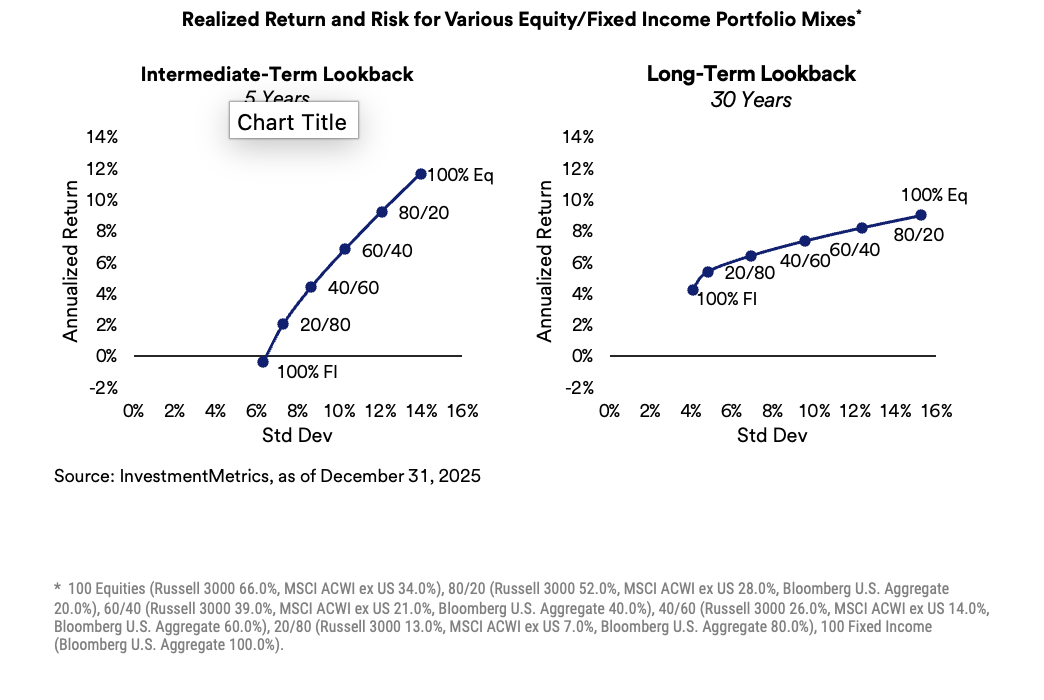
Fixed income serves as the ballast of a portfolio, providing principal preservation qualities and predictable, stable income returns. Equities provide the critical capital appreciation potential necessary for investors to meet their long-term return objectives. By combining equities and fixed income in varying proportions, investors can construct multi-asset portfolios designed to align with long-term risk and return objectives as seen in the chart below.