The Credit Story Behind AI: How the Data Center Buildout Is Reshaping Capital Markets
October X, 2026
By Winnie Cheng, CFA, Director, Senior Credit Research Analyst
Artificial intelligence is often treated as a software story. From a credit perspective, the physical infrastructure behind the technology may be just as consequential.
The buildout is driving investment in data centers, power systems, networking equipment, and semiconductors. For investors, the central questions are how companies are financing that expansion, how quickly new capacity can generate revenue, and whether increased leverage and lower free cash flow before that revenue materializes could affect their credit risk profiles.
Demand is rising faster than capacity can come online
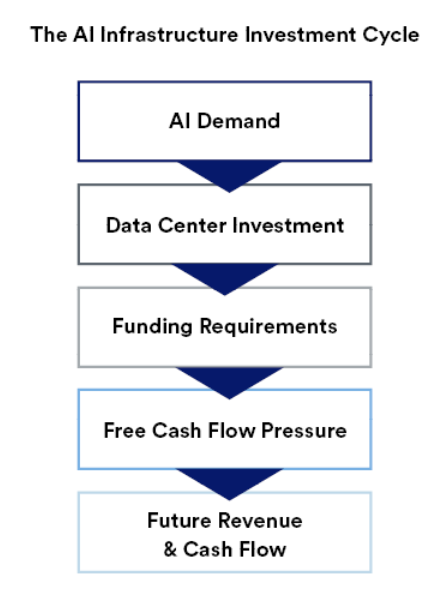
AI training for large language models and the growing use of AI by businesses and consumers are increasing demand for computing capacity. Yet a large AI data center can take approximately two to three and a half years to reach operational readiness, based on our analysis. While data center developers are building or investing in electrical power sources, they are dependent on power availability and connection to the electrical grid that is outside of their control. The lag between demand, construction, and operational readiness can produce uneven revenue growth as capacity comes online and contracted obligations convert into revenue.
The investment question is therefore not only whether demand exists. It is whether an issuer can align construction, financing, and customer commitments well enough to monetize capacity on schedule. That challenge is compounded by the different economic lives of the underlying assets. Our analysis estimates that data center shells can remain useful for more than 30 years, while servers, storage and networking equipment may require replacement every five to seven years. New generations of AI accelerators are being developed more quickly still.
A durable facility may support several generations of equipment, but recurring hardware investment is necessary to keep capacity competitive. Investors should consider contract length, utilization, refresh costs, and which party bears the risk of technological obsolescence.
Financing choices determine how the buildout reaches the balance sheet
Companies are using public debt, private debt, preferred stock, common equity, project or structured finance, asset-backed securities and leases to fund expansion. Additionally, large cloud providers such as Amazon, Microsoft and Alphabet have accessed debt markets outside the United States to broaden their sources of liquidity. Companies are signing operating leases with data center developers to reduce upfront cash outlays, but the development costs are reflected in the lease payments. Operating lease obligations are included in adjusted leverage calculations as part of assessing a company's credit risk and financial flexibility.
The effects are already visible in free cash flow. Higher capital expenditures have put pressure on free cash flow across several large cloud providers. Based on our analysis of the latest company filings available through June 2026, Amazon and Oracle reported negative trailing free cash flow, while Microsoft, Alphabet and Meta remained positive. The companies also reported substantial cash and investments, providing varying degrees of liquidity support. 1
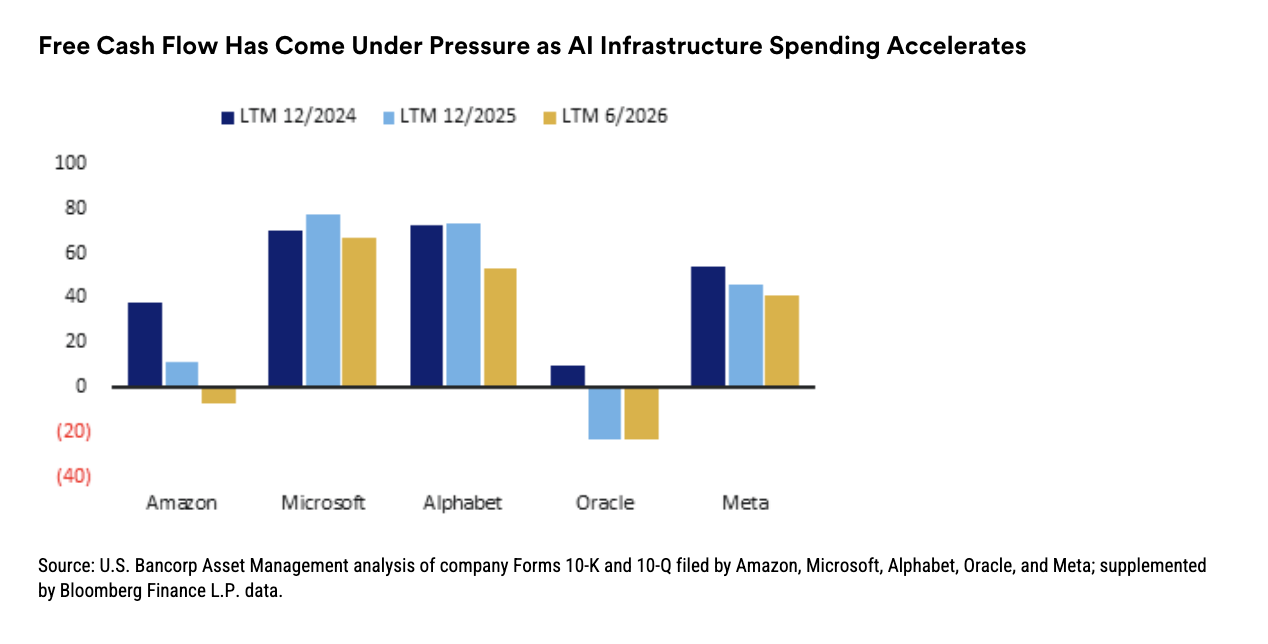
Weak or negative free cash flow is not, by itself, evidence that the investment is uneconomic. The credit issue is whether an issuer can bring assets online, convert capacity into revenue, and moderate leverage within a timeframe consistent with its rating profile.
Scale provides a cushion, but execution will separate credit outcomes
In our view, the largest cloud providers are generally better positioned because of their scale, revenue growth, diversified customer bases, and financial flexibility. Risk can be greater where an issuer enters the cycle with elevated leverage, less financial flexibility, or significant customer concentration. Construction delays, power constraints, changing technology, and weaker-than-expected utilization can all slow the conversion of investment into cash flow.
Compared with the largest cloud providers, Oracle’s smaller scale, higher leverage, and customer concentration may contribute to greater downgrade risk. S&P downgraded Oracle to BBB- in July 2026 and Moody’s assigned a negative outlook to its Baa2 rating in July 2025.2
For credit investors, the most useful monitoring framework connects operating progress to financing capacity: the conversion of contracted demand into revenue; capital expenditures and free cash flow; the mix of debt, equity, leases and structured financing; adjusted gross and net leverage; customer concentration; construction schedules; power availability; and hardware-refresh costs relative to contract terms.
AI infrastructure is already influencing capital allocation, free cash flow, and credit profiles. Technological capability will matter, but so will financing discipline, execution and the conversion of capacity into durable cash flow. Beyond understanding AI technology, it is important to assess the assets and obligations of the AI operators to determine credit worthiness.
If you have any questions or would like more information, please reach out to your relationship manager.
2 S&P Global Ratings, Moody's Ratings, Fitch Ratings, and company SEC filings.